Starting July 1, 2026, Vietnam officially implemented new entry regulations — all arriving travelers (regardless of nationality or visa type) must complete three electronic declarations to clear immigration smoothly. Taiwan passport holders entering Vietnam require an electronic visa (E-Visa), along with the newly launched health declaration and PAI pre-arrival registration, adding several more steps than before. This guide breaks down every step so you can follow along and get it done.
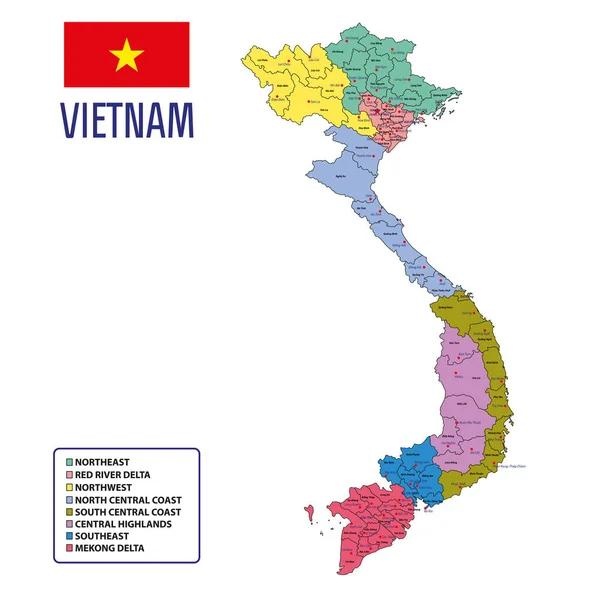



(Image source: Vietnam E-Visa official website thithucdientu.gov.vn)
1. Visa Guide: E-Visa Application Tutorial
Taiwan passport holders entering Vietnam (except Phu Quoc Island) must obtain a visa in advance. The most convenient option in 2026 is the E-Visa — the entire process is handled online, no embassy visits required. You can complete it from the comfort of your home.
E-Visa Basic Information
| Item | Details |
|---|---|
| Fee | Single entry USD $25 / Multiple entry USD $50 |
| Duration of Stay | Up to 90 days |
| Processing Time | 3–5 business days |
| Ports of Entry | 83 international ports (airports, land borders, seaports) |
| Official Website | evisa.xuatnhapcanh.gov.vn (old site, now redirected to thithucdientu.gov.vn) |
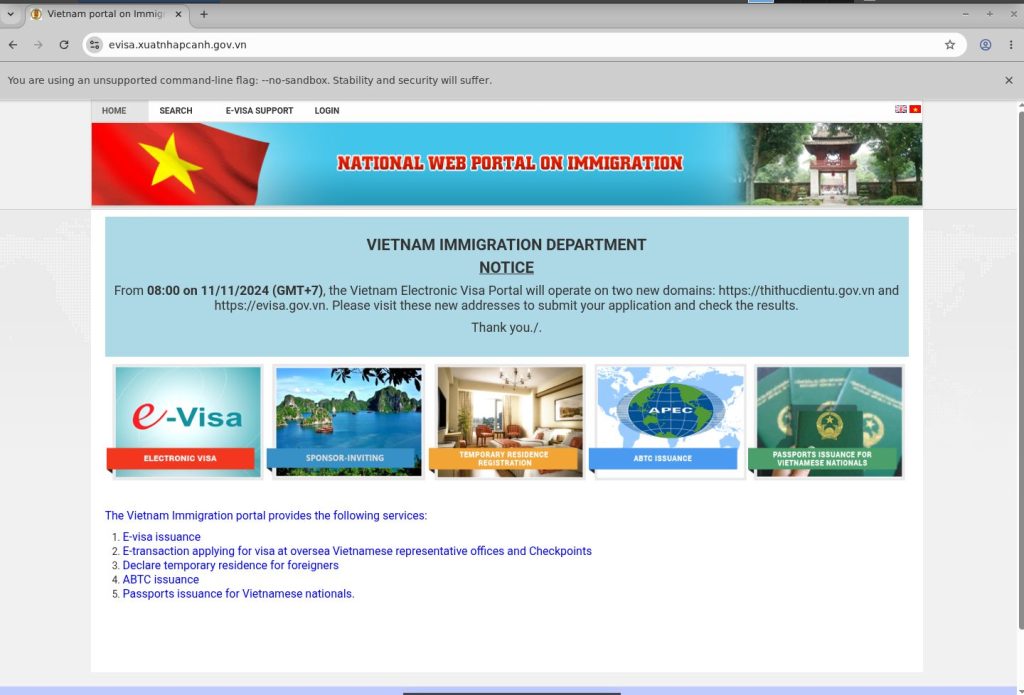
(Screenshot source: Vietnam Immigration Department official website evisa.xuatnhapcanh.gov.vn)
Application Steps
Step 1: Prepare Your Documents
Passport valid for at least 6 months (from date of entry), with at least 2 blank pages. A white-background ID photo (4×6 cm, taken within the last 6 months, no glasses). A clear scanned copy of your passport’s biographical data page (JPEG format, under 2 MB).
Step 2: Visit the Official Website
Open the Vietnam Immigration Department’s official E-Visa website thithucdientu.gov.vn and click “Khai báo tại đây” (Apply here) to begin filling out the form. ⚠️ Do NOT click on third-party agent websites from search engines — many fake sites charge extra processing fees.
Step 3: Fill Out the Application Form (NA1 Form)
The spelling of your name must exactly match the machine-readable code at the bottom of your passport. Be careful distinguishing the number 0 from the letter O, and the number 1 from the letter I when entering your passport number. Choose the correct port of entry — if you’re flying into Hanoi, select Noi Bai; if entering via the Huu Yi land border crossing, select Huu Nghi. Choosing the wrong port may result in denial of entry by customs.
Step 4: Upload Documents
Upload your passport scan and ID photo — both must be in JPEG format and under 2 MB. Blurry photos will be rejected and returned for resubmission, wasting several days.
Step 5: Online Payment
Visa and Mastercard are accepted. Single entry costs $25; multiple entry costs $50. ⚠️ This fee is non-refundable once the application is submitted — regardless of whether it’s approved, rejected, or contains errors. If you discover a mistake, you’ll need to reapply and pay again.
Step 6: Receive and Print Your Visa
After 3–5 business days, you’ll receive an email notification. Log in to the system to download your E-Visa PDF. We recommend printing at least 2 copies on A4 color paper — black-and-white is acceptable, but color prints show the red stamp and QR code more clearly, which can speed up immigration processing.

(Image source: Vietnam E-Visa official website thithucdientu.gov.vn)
Comparison of Three Visa Options
| Comparison | E-Visa | Visa on Arrival (VOA) | Embassy Visa (Taipei) |
|---|---|---|---|
| Application Method | Fully online | Online approval letter, then stamp at airport | In-person submission |
| Duration of Stay | Up to 90 days | 15–90 days | Depends on visa type |
| Number of Entries | Single / Multiple | Single / Multiple | Single / Multiple |
| Applicable Ports | 83 ports (airport/land/seaport) | International airports only | All ports |
| Additional Fees | None | $25–50 USD cash stamping fee at airport | Varies by visa type |
| Best For | Tourism, short business trips, independent travelers | Last-minute travelers who couldn’t get an E-Visa in time | Those requiring long-term work visas |
2. PAI Pre-Arrival Electronic Registration
PAI (Pre-Arrival Information) is Vietnam Immigration’s new pre-arrival electronic registration system launched in 2026. It was first piloted at Tan Son Nhat Airport (SGN) in Ho Chi Minh City starting April 15, 2026, and has since expanded to Noi Bai Airport (HAN, from July 1), Phu Quoc Airport (PQC, from June 1), and Da Nang Airport (DAD, from June 15).
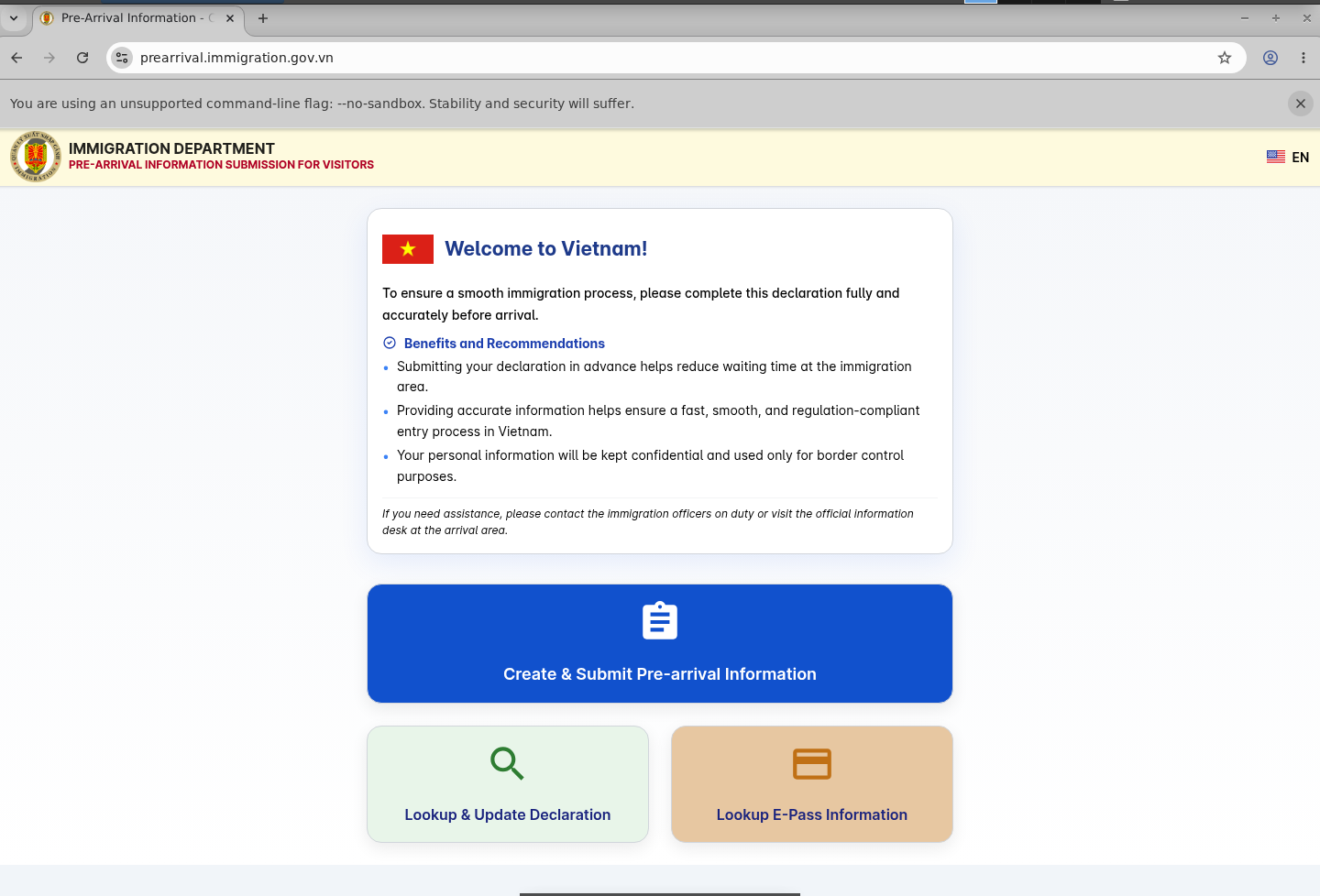
(Screenshot source: Vietnam Immigration PAI system prearrival.immigration.gov.vn)
PAI Basic Information
| Item | Details |
|---|---|
| Official Website | prearrival.immigration.gov.vn |
| Fee | Free |
| When to Fill | Within 72 hours before arrival (submitting too early will invalidate it) |
| Currently Applicable Airports | Ho Chi Minh City (SGN), Hanoi (HAN), Phu Quoc (PQC), Da Nang (DAD) |
| Output | Personal QR code |
Filling Steps
Step 1: Visit the Official Website
Open prearrival.immigration.gov.vn on your phone or computer browser. You can switch to Simplified Chinese in the upper right corner. Click “Create & Submit Pre-arrival Information” to begin.
Step 2: Fill in Personal Traveler Information
All information must match your passport exactly, character for character. You can upload a photo of your passport’s data page to let the system auto-fill and reduce manual entry errors. Required fields: arrival date, full name, passport number, date of birth, nationality, email address, and mobile phone number.
Step 3: Fill in Visa Information
Select E-Visa, then enter your visa number, issue date, and expiry date. This information must match your printed/electronic visa exactly.
Step 4: Itinerary & Accommodation Information
Enter your country of departure, port of entry, flight number, purpose of travel (tourism/business/etc.), and the full address of your first night’s accommodation (including street, district, and city). The accommodation address must be genuine — the system will verify it online.
Step 5: Verify and Submit
After double-checking everything, the system will send a 6-digit OTP verification code to your email. Enter the code, check the declaration box, and submit. The system will automatically generate a receipt with a QR code. Take a screenshot and save it to your phone; we also recommend printing a paper copy as backup.
PAI Important Notes
⚠️ Once submitted, the information cannot be modified. Errors in name capitalization or passport numbers will invalidate your QR code, and you’ll need to start over. Each traveler must submit an individual form — group/combined applications are not allowed. Airport WiFi can be unreliable, so it’s best to complete the form before departing. If multiple submissions fail, try a different browser or disable your VPN.
3. Electronic Health Declaration (New Policy Effective July 1, 2026)
Under Decree No. 165/2026/NĐ-CP issued by the Vietnamese government, all travelers entering, exiting, or transiting through Vietnam (regardless of nationality, including Vietnamese citizens) must complete an electronic health declaration starting July 1, 2026.
Health Declaration Basic Information
| Item | Details |
|---|---|
| Legal Basis | Decree 165/2026/NĐ-CP |
| Effective Date | July 1, 2026 |
| When to Fill | Within 7 days before entry |
| Applicable To | All cross-border travelers (regardless of nationality) |
| Applicable Ports | All ports (airports, land borders, seaports) |
| Fee | Free |
| Submission Method | Electronic declaration (preferred) or paper form |
Health Declaration Portals
According to Decree 165/2026/NĐ-CP, there are two ways to submit the health declaration:
Method 1: Electronic Declaration (Preferred)
The electronic declaration platform is managed by Vietnam’s Ministry of Health (Bộ Y tế). As of early July 2026, the official online portal has not yet been formally launched. Travelers are advised to check the following official channels for the latest declaration URL before departure:
- Ministry of Health official website: moh.gov.vn (check homepage announcements)
- PAI Pre-Arrival Registration System: prearrival.immigration.gov.vn (health declaration may be integrated into this platform)
- Vietnam Government Portal: chinhphu.vn (search “khai báo y tế” for the latest link)
Method 2: Paper Form
If the electronic platform is not yet available or accessible, you may use the standard paper form (Appendix V of Decree 165/2026/NĐ-CP), which can be filled out on-site at the port of entry. The form is available in both Vietnamese and English.
The declaration includes: personal information, recent travel history, countries visited in the past 14 days, health status, and contact information in Vietnam. Upon completion, a unique QR code will be generated, which will be checked by both immigration and health quarantine officers.
Important Reminder: The health declaration and PAI pre-arrival registration are two separate systems — they must be completed independently and cannot replace each other. Failure to complete or providing inaccurate information may result in on-the-spot fines or denial of entry. Both entry/exit and transit require declaration. Before departure, please verify on the Ministry of Health website whether the electronic platform is live; if not, prepare paper forms as backup.
4. Customs Declaration
If you are carrying any of the following items, you must declare them proactively and use the declaration channel:
| Declaration Item | Limit |
|---|---|
| Foreign currency (cash) | Exceeding USD $5,000 |
| Vietnamese Dong (cash) | Exceeding VND 15,000,000 |
| Gold, jewelry | Must be declared |
| Tobacco & alcohol | Must be declared if exceeding duty-free allowance |
| High-value electronic devices | Must be declared |
⚠️ False or incomplete declarations may result in fines of up to VND 50,000,000 (approximately USD $2,000).
5. Immigration & Arrival Process
Here’s the step-by-step process after arriving in Vietnam:
1. Proceed to the immigration hall after disembarking
2. Present your passport + E-Visa (color printed copy)
3. Present your PAI QR code (phone screenshot or printed copy)
4. Present your Health Declaration QR code (phone screenshot or printed copy)
5. If you have items to declare, proceed through the customs declaration channel
6. Collect your luggage and pass through customs inspection
If all documents are in order, the entire process typically takes 10–15 minutes. Ho Chi Minh City Airport offers a Fast-Track lane for travelers who have completed PAI registration, reducing clearance time to under 10 minutes.
6. Phu Quoc Visa-Free Special Rules
Phu Quoc Island is the only region in Vietnam that offers visa-free entry for Taiwan passport holders, but the conditions are strict:
✅ Direct flights to Phu Quoc International Airport (PQC): visa-free stay for 30 days
✅ Or transit through a Vietnamese international airport (without clearing immigration) before flying to Phu Quoc
❌ If your itinerary includes Vietnamese mainland cities such as Hanoi, Ho Chi Minh City, or Da Nang, you must obtain a visa in advance
❌ Traveling from Phu Quoc to mainland Vietnam voids the visa-free status; a separate visa is required
Even when entering Phu Quoc visa-free, you must still complete PAI pre-arrival registration (mandatory from June 1) and the health declaration.
7. Pre-Departure Checklist
Before departure, use this checklist to make sure everything is in order:
| Item | Status |
|---|---|
| Passport valid for 6+ months | ☐ |
| E-Visa (2 color printed copies) | ☐ |
| PAI Registration QR code (screenshot + printout) | ☐ |
| Health Declaration QR code (screenshot + printout) | ☐ |
| Round-trip flight booking confirmation | ☐ |
| Accommodation booking confirmation (with full address) | ☐ |
| Customs declaration form (if applicable) | ☐ |
8. Frequently Asked Questions (FAQ)
Q: Can I just fill out either the PAI registration or the health declaration?
No. These are two separate systems. PAI is the Immigration Department’s pre-arrival registration, while the health declaration is the Ministry of Health’s health monitoring form. Both must be completed independently.
Q: What if I made a mistake on my E-Visa application?
Once submitted, E-Visa applications cannot be modified and fees are non-refundable. You’ll need to submit a new application and pay again. We recommend carefully reviewing every field before submission.
Q: Can I extend my E-Visa while inside Vietnam?
No. E-Visas cannot be extended within Vietnam. If you need to extend your stay, you must leave the country and re-enter with a new visa (commonly known as a “visa run”).
Q: Do I need PAI registration at land border crossings?
Currently, the PAI system primarily applies to international airports, but land border crossings are expected to be gradually included. The health declaration applies to all ports of entry.
Q: What’s the difference between Visa on Arrival (VOA) and E-Visa?
VOA requires applying for an Approval Letter online in advance, then queuing at the airport to pay and get your visa stamped. It’s only available at international airports. The E-Visa is fully processed online — once approved, simply print it out and use it directly. It supports 83 ports including airports, land borders, and seaports, making it much more convenient.
Q: What do I need when traveling with children?
Children under 14 who are listed on a parent’s passport can enter under the parent’s visa. Children holding their own passports must apply for a separate E-Visa. Every traveler (including children) must complete PAI registration and the health declaration.
9. Vietnam Accommodation Recommendations
With your visa and declarations sorted, it’s time to find a place to stay. tournews.tw has prepared comprehensive accommodation guides for 10 major cities in Vietnam, each featuring handpicked hotels and direct booking links:
- Vietnam Accommodation Guide | 10 Major Cities Accommodation Hub Page
- Ho Chi Minh City Accommodation | 12 Quality Boutique Hotels in District 1
- Hanoi Accommodation Guide | 20+ High-Value New Hotels in the Old Quarter / Hoan Kiem District
- Da Nang Accommodation | 12 Five-Star Hotels & Ocean-View Villas
- Phu Quoc Accommodation Guide | North Island, Central Island & Sunset Town – 3 Key Areas
- Nha Trang Accommodation | 12 High-Value Ocean-View Hotels
- Da Lat Accommodation | 12 Unique Stays
- Hue Accommodation | 12 Quality Hotels in the Ancient Capital
- Ha Long Bay Accommodation | 12 Bay-View Resort Hotels
- Hoi An Accommodation | 12 Ancient Town Hotel Picks
- Sapa Accommodation | 10 Dreamy Hotels in the Misty Mountain Town
Last updated: July 2, 2026. Vietnam entry policies are continuously updated — please verify the latest regulations on official websites before departure. Image sources: Vietnam Immigration Department (evisa.xuatnhapcanh.gov.vn), Vietnam E-Visa Portal (thithucdientu.gov.vn), Vietnam Immigration PAI System (prearrival.immigration.gov.vn).